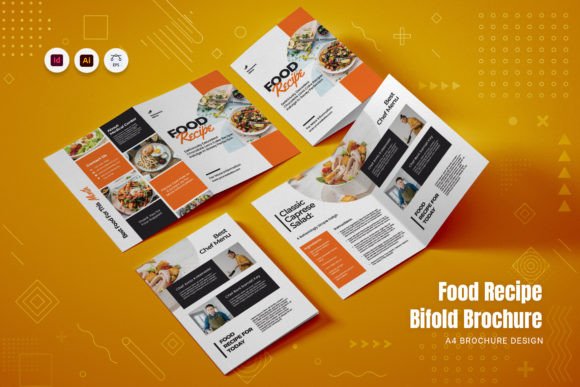
Unlocking Culinary Creativity: The Power of a Food Recipe Bifold Brochure
In the vibrant world of culinary arts and food marketing, presentation is just as crucial as taste. Whether you are a professional chef launching a new menu, a home cook sharing family secrets, or a business promoting a cooking class, the medium through which you deliver your message matters immensely. This is where the Food Recipe Bifold Brochure emerges as an indispensable tool. It bridges the gap between traditional print media and modern design aesthetics, offering a compact yet comprehensive way to share information.
A bifold brochure, by definition, is a single sheet of paper folded once to create four panels. This simple structure provides enough space to tell a story, list ingredients, and provide step-by-step instructions without overwhelming the reader. When designed correctly, it becomes more than just a piece of paper; it becomes a tangible experience that engages the senses before the first bite is even taken.
Why Choose a Bifold Format for Recipes?
You might wonder why a bifold is preferred over a tri-fold or a standard flyer. The answer lies in balance and usability. A tri-fold can sometimes feel cramped, forcing text into narrow columns that are difficult to read while cooking. A single-page flyer lacks the depth needed for detailed instructions. The bifold offers a "book-like" experience that opens up to reveal a spread, allowing for large, appetizing images on one side and clear, legible text on the other.
This format is particularly effective for:
- Marketing Campaigns: Restaurants can use them as take-away menus or promotional inserts.
- Educational Purposes: Cooking schools can distribute them as handouts for specific classes.
- Brand Building: Food bloggers and influencers can create physical merchandise for their followers.
The Importance of Professional Design Templates
Creating a brochure from scratch requires significant time and design expertise. This is where pre-designed templates come into play. A high-quality Food Recipe Bifold Brochure template allows you to share content in an informative and creative way, whether for marketing or education. These templates are not just placeholders; they are structured frameworks built on principles of visual hierarchy and readability.
One of the primary advantages of using a professional template is the ability to modify the mockup’s elements anytime. You are not locked into a rigid design. Instead, you have the freedom to adjust colors, fonts, and images to match your brand identity. This flexibility ensures that your final product looks custom-made, even if you started with a base template.
Key Features of a High-Quality Template
When selecting a template for your culinary project, it is essential to look for specific technical and aesthetic features. These features ensure that the final output is not only beautiful but also practical for printing and editing.
- Easy to Use and Customize: The best templates are designed with the user in mind. They should be intuitive, allowing even those with basic design skills to make meaningful changes.
- Fully Layered and Well-Organized: A chaotic file structure can turn a simple edit into a nightmare. Look for templates where every element—text, images, backgrounds—is on its own layer, clearly labeled.
- Print-Ready Specifications: For physical brochures, quality is non-negotiable. Ensure the template is set to A4 Paper Size, uses CMYK color mode for accurate printing, and has a resolution of 300 DPI. This guarantees sharp images and crisp text.
- Bleed Included: Bleed is the area beyond the edge of the page that gets trimmed off. Including bleed prevents unwanted white borders if the cutting is slightly off-center.
Software Compatibility and File Formats
Versatility in file formats is another critical aspect. A robust template package should include files for industry-standard software. Typically, this means including:
- Ai (Adobe Illustrator): Ideal for vector-based designs that need to be scaled without losing quality.
- INDD (Adobe InDesign): Perfect for layout-heavy documents with substantial text, offering superior typography controls.
- Readme .txt: A simple guide that explains how to use the template, install fonts, and export files correctly.
Having these options ensures that you can work in the environment you are most comfortable with. Furthermore, the use of free fonts is a significant benefit. It eliminates the need for expensive licensing fees and ensures that anyone who downloads the template can open and edit it without missing font errors.
Practical Applications in Modern Life and Business
The relevance of the Food Recipe Bifold Brochure extends far beyond the kitchen. In today’s digital age, physical touchpoints have become premium marketing assets. People are inundated with digital ads, making a well-crafted physical brochure stand out as a tangible, memorable item.
For businesses, these brochures serve as excellent leave-behinds after catering events or food festivals. They keep your brand in the customer’s home, increasing the likelihood of repeat business. For educators, they provide a structured way to teach cooking techniques, breaking down complex processes into manageable steps.
Moreover, the clean and modern layout of these templates aligns with contemporary design trends. Minimalist aesthetics, ample white space, and high-quality photography create a sense of sophistication. This style is not just visually appealing; it enhances readability, which is crucial when a user is trying to follow a recipe with messy hands.
Common Misunderstandings About Print Design
Many beginners assume that designing for print is similar to designing for web. This is a common misconception. Web designs use RGB color modes and lower resolutions (72 DPI) to load quickly on screens. Print designs, however, require CMYK and 300 DPI to ensure color accuracy and sharpness on paper. Using a web-optimized image for a print brochure will result in pixelated, blurry outputs.
Another misunderstanding is that templates limit creativity. In reality, a stylish web template layout or print template provides a foundation that frees you from technical constraints. By handling the structural heavy lifting, the template allows you to focus on content creation and branding. You can easily swap out image placeholders, adjust paragraph styles, and experiment with color schemes without worrying about alignment issues.
How to Get Started with Your Brochure
Starting your project is straightforward if you follow a logical process. First, gather your content. Write your recipe, select high-resolution images, and define your brand colors. Next, choose a template that matches your vision. Look for one that is fully layered and includes built-in free fonts.
Once you have your file open, start by replacing the placeholder images. Ensure your photos are high-quality and relevant to the recipe. Then, input your text, utilizing the predefined paragraph styles to maintain consistency. Pay attention to hierarchy; headings should be bold and clear, while instructions should be easy to scan.
Finally, review your design. Check for spelling errors, ensure all images are properly aligned, and verify that the bleed settings are correct. When you are satisfied, export the file in the appropriate format for printing. If you are sending it to a professional printer, a PDF with bleed marks is usually the standard requirement.
Conclusion
The Food Recipe Bifold Brochure is more than just a marketing tool; it is a vessel for sharing culture, knowledge, and passion. By leveraging professionally designed templates, you can create stunning, print-ready materials that resonate with your audience. Whether you are using Adobe Illustrator or InDesign, the key is to utilize the organized layers, free fonts, and print-ready specifications provided.
Remember, the goal is to make the information accessible and engaging. With the right template, you can achieve a clean and modern layout that elevates your recipes from simple instructions to an artistic experience. Embrace the ease of customization, respect the technical requirements of print design, and let your culinary creativity shine through every fold.
For those looking to dive deeper into design resources, exploring platforms that offer super easy to edit templates can save you hours of work. Start today, and transform the way you share your favorite dishes with the world.